
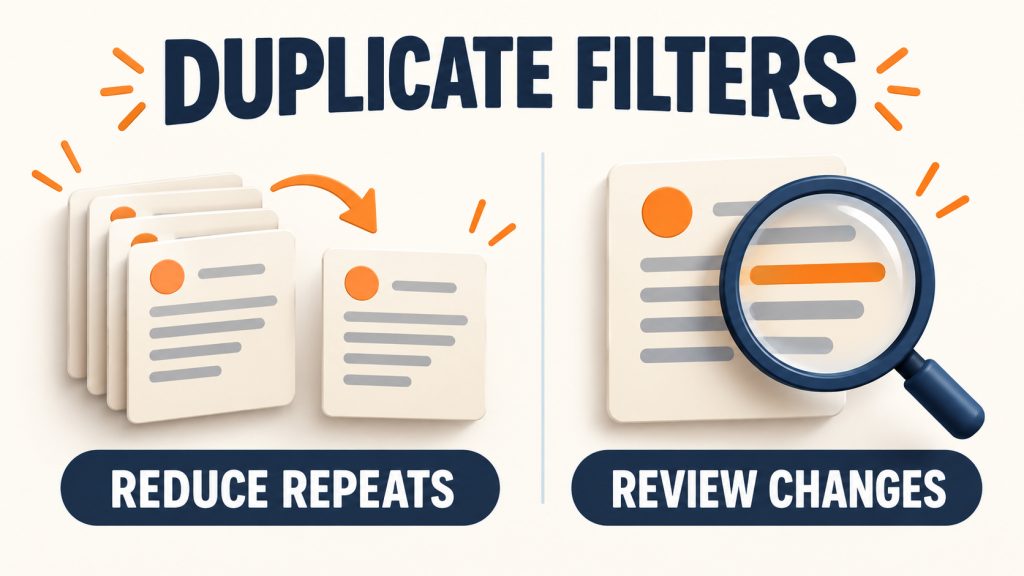
Reduce repeated messages without treating every post about the same product as disposable. RedFox Auto Forward Telegram’s Duplicate Filters can help keep a busy deal channel from receiving the same content repeatedly. The practical choice is to suppress redundant reposts while checking that useful changes in source terms remain visible.
Start with one private route and compare an identical repost, a changed post about the same item, a different image and matching content from another source. These cases answer a better question than “is dedup on?”: does this configuration reduce the noise you intended without removing the updates your readers need?
Product identity: use RedFox Auto Forward Telegram (@AutoForwardNew_Bot). The previous @Auto_Forward_Messages_Bot has moved to this current handle. Configure your tasks through the Web dashboard.
AffiliateTelegram is AutoForward Messages’ official affiliate-workflow partner. We explain setup and use cases; AutoForward supplies the forwarding platform.
1. Separate a repeated message from a repeated product
Redundant repost
The same message appears again without new information. Your editorial goal is usually one useful appearance in the intended channel, rather than multiple copies of unchanged text.
Same item, useful new source terms
The source publishes a new post about the same item with a changed price, variant, availability statement, purchase condition or correction. Readers may need that update. Compare the actual terms before deciding to discard it; sharing an item name does not make two posts equivalent.
Different presentation, uncertain new value
A new photo or caption may show a different variant—or may simply repackage the same information. Make the editorial decision from the content, not just the presence of another image.
The original Duplicate Filters guide describes reducing repeated messages to the same groups or channels and configuring the feature in task settings. It does not describe universal same-product, ASIN or SKU recognition. Nor does it make the bot a live merchant-price checker or an expired-offer detector.
Choose your policy first: suppress unchanged reposts, retain materially useful new information, and inspect uncertain cases. That is your channel policy, not a promise that the software automatically makes every editorial decision.
2. Do not assume a new image or changed price will always pass
The relevant new-message implementation compares message content rather than a universal product identity. It prefers text or a caption when present, with a media identifier used when text is absent. Text comparison lowercases the content before matching. The public AutoForward setup guide also describes lowercased exact-content repeat reduction.
- Capitalization alone: changing letter case is not a dependable way to make a repost distinct.
- Same caption, different photo: do not rely on the image difference to keep the second post. A text-based comparison can still see the caption as a repeat.
- Changed source terms: changed text can differ under content matching, but a later cleanup or rewrite may erase the useful distinction. Check the final forwarded content as well as the source.
- No caption: media identifiers are not the same as recognizing the same product in two different photographs. Albums also need their own check; do not extend a single-photo result to every grouped-media post.
These explain what to test, not a claim of results from your account. Source-side and target-side checks can look at different stages; the inspected target path can compare processed content and original text. Adding a cosmetic suffix is therefore not a reliable way to override duplicate control. Leave unnecessary transformations out of the first comparison.
Useful update retention needs two checks: the changed post reaches the destination, and its meaningful change remains readable there. A second target message with the same stale terms does not meet that goal.
3. Map where repeats enter and where they should stop
Write down the actual route before changing settings. A short private route note is enough:
- Sources: which authorized feed or feeds can publish the repeated content?
- Tasks: which active forwarding tasks read those feeds?
- Destination: which exact channel receives their output?
- Mode and memory: what duplicate settings, retention period and remembered-item limit does each affected task expose and retain after saving?
A source-side check concerns repeats entering from a source; a target-side check concerns content headed to a destination. The relevant implementation uses source-chat and target-chat identities for those comparisons. A setting edited in one task is not proof of a completely isolated duplicate history for that task. Routes sharing a destination need a combined check.
Equally, do not assume all sources, all accounts or all destinations share one global history. If two tasks send to the same target, test matching posts from their respective sources. If the same source feeds two different targets, inspect both targets. Source and target choices can change the behavior you care about.
Retention and remembered-item limits matter: content no longer in the comparison history may be eligible again. The public setup guide describes a standard preset, while advanced controls are plan-dependent. Read the values actually saved for your task instead of copying a number from a different route. A large remembered-item limit is not a product catalogue, and a long retention period is not proof that an offer is still valid.
Keep this walkthrough to ordinary new-message forwarding. A new updated post and an edit to an already-forwarded source message are different events. If your feed edits existing posts, check that edit behavior separately rather than assuming the four new-post cases prove it. History cloning and scheduled posting likewise need checks in their own workflows.
4. Configure a private route before a busy feed
- Prepare empty private test chats. Use a source and target you control, with no real audience. For the multiple-source case, prepare a second private source. Use text and images you have permission to reproduce.
- Create the route, then pause immediately. The official creation guide says a new task is activated. Keep sources empty until the paused state is confirmed. Our first-task walkthrough covers endpoint selection.
- Check a simple baseline. With Duplicate Filters disabled for this private comparison and no restrictive rules, activate the route briefly, post permitted baseline content and confirm delivery. Pause again before configuration. If the baseline does not arrive, fix the route or access first.
- Open Detail Task Forward → Duplicate Filters. This is the navigation named in the original guide. Enable the feature using your current surface’s available controls, choose the parameters it exposes, and save. Verify your account’s feature availability; do not assume every plan has the same advanced options.
- Reopen the same task. Record the enabled state, visible source/target options, retention units and remembered-item limit. Do not guess an unshown field, turn a source option into a global promise, or use an all-task action to configure one test.
- Keep the comparison readable. Leave optional AI rewriting, Cleaner and Replace out initially. Note any existing rules, delay and other tasks reaching the target. After the plain check, add the transformations you really need one at a time and repeat the changed-post case.
Open AutoForward and review Duplicate Filters in a paused private task →
Use new sample wording for the enabled comparison, rather than assuming that pausing, deleting a target message or saving a setting cleared prior duplicate history. Activate deliberately, add the cases one at a time, inspect the actual target, and pause again when finished. Activated tasks run in RedFox’s cloud without keeping the app or dashboard open; closing the management screen is not a pause.
5. Use four cases to compare noise reduction and update retention
This original matrix is a non-runnable test design, not a record of bot outcomes. Bracketed terms are labels for information, not prices, discounts, working links or real offers. For an actual check, use permitted source content and retain the real changed terms privately. Keep sequence labels in your notes, not inside repeated captions: changing the caption to label each test would stop it being an identical repost.
Case A — identical repost
- Input pair: two new source messages with identical text,
[item description] — [source terms] — [permitted product link]. Use matching media if media is included. - Editorial target: retain the first useful post and suppress the redundant second appearance.
- Sourced expectation: repeated matching content is the feature’s documented use, provided the first content remains in the applicable history and the feature is active.
- Observed target messages and times: __________
- Action after inspection: __________
Case B — same item, updated source terms
- Input pair: a new post about the same item using
[original source terms], followed by a new post using[updated source terms]. Preserve the actual changed wording, including a changed price if the real authorized source supplies one. - Editorial target: keep the material update and make its difference visible.
- Matching question: does the change remain distinct at the stages compared by your settings, or does a transformation collapse both messages to the same content? Same item identity alone does not establish a duplicate. Delivery is not promised for every changed post.
- Observed output and retained difference: __________
- Action after inspection: __________
Case C — different image, same caption
- Input pair: two permitted images with the same caption,
[item description] — [unchanged source terms]. - Editorial target: decide whether the new image adds meaningful variant or product information before deciding it should stay.
- Matching question: with text prioritized, the same caption can remain a duplicate despite the different image. Separately test uncaptioned photos or albums if those are part of your feed.
- Observed target and useful visual difference: __________
- Action after inspection: __________
Case D — matching content from multiple sources
- Input pair: source A publishes a new message; source B later publishes the same content. Use the intended task arrangement, with both routes pointing only to the private test target. Record the real source and task identities privately.
- Editorial target: avoid a redundant second appearance in that target while retaining genuinely different source information.
- Scope question: a target comparison can encounter matching content from different sources in its own history. This is not evidence of cross-account or whole-system deduplication. A result from one source-only check does not answer this case.
- Observed result by source, task and destination: __________
- Action after inspection: __________
For each case, retain the source text or caption, media type, task settings, posting order, actual target output and whether the meaningful information survived. Mark an unclear result unresolved, not “blocked as intended.” A saved configuration or a non-posting preview is not an observed target result.
6. Interpret the result before changing more settings
An identical repost still arrives
Check that you inspected the intended task and target, that Duplicate Filters stayed enabled after saving, and that the content really was identical. A different URL, footer, caption or transformation can change the compared text. Review retention and remembered-item limits, and look for another active route delivering to the same target. Simultaneous sends, restarts and evicted history mean this is repeat reduction, not a zero-duplicate guarantee.
A useful changed post disappears
Pause the affected route. Compare the original and changed messages and check whether Cleaner, Replace or rewriting removed the meaningful distinction. Also check whitelist, blacklist and type exclusions: missing output alone does not identify the duplicate filter as the cause. Re-run a private comparison changing only the suspected setting. If you cannot keep the material update reliably, use a curated route for those updates rather than assuming they are protected automatically.
The same caption hides a useful new photo
Do not simply add invisible characters or random text to evade matching. If the image communicates a genuine change, make that change clear in an authorized source caption and test the intended workflow again. If the source cannot be changed, choose a separate editorial route or a duplicate configuration suited to that content after a private check.
Delivery or suppression is uncertain
Inspect the exact target before resending. A message absent from your current screen might have arrived earlier or through another route. Do not reset all settings or delete other tasks to obtain a clean-looking result. If support is needed, provide the task label, time, sanitized content pair, selected settings, expected action and actual destination evidence—never credentials, API keys or unauthorized source material.
7. Expand with an update policy, not a same-product ban
Keep the route paused while replacing test endpoints with the authorized live sources and intended audience channel. Confirm source-content rights, posting access and applicable affiliate placement rules. Check every active route that can reach this target, then activate deliberately and inspect early output.
- Retain useful changes: corrections, changed variants and changed purchase conditions deserve an editorial decision, not automatic rejection because the product name repeats.
- Check final content: a useful new price or condition must survive any transformation. Duplicate control does not validate the merchant page or guarantee link attribution.
- Recheck after changes: a new source, shared destination, rule or media format can invalidate an earlier narrow comparison.
- Keep expiry separate: verify time-sensitive offers through the permitted source or merchant. Duplicate Filters does not decide which deals have expired.
Your next step: use the four-case matrix in a private route and choose the smallest configuration that suppresses unchanged reposts while keeping your meaningful updates readable. Review the actual task in the AutoForward dashboard; expand only after inspecting the output you intend to rely on.